Bumbu Sherpu — Guru Rinpoche’s golden kalash, now turned to stone. In Buddhist tradition, the sacred vase holds the blessings of long life, purity and abundance.
Google “Nepal trekking” and you’ll find thousands of pages about Everest and Annapurna. Both are incredible. Both also have queues.
Jugal is different. It’s one of the nearest Himalayan base camps to Kathmandu, just a few hours’ drive away in Sindhupalchok, with zero crowds.
The peaks: Dorje Lakpa, Lenpo Gang, Phurbi Chyachu, Lady Peak and Gyalzen Peak. From the newly opened Jugal Everest View Point, the horizon stretches for about a hundred kilometres.
A sacred Beyul: a hidden valley where Guru Rinpoche (Padmasambhava) meditated in the 8th century. Prayer flags, juniper smoke at dawn, mani stones, and sacred places like Ne-Pemachhal and Bumbu Sherpu.
Here's what you're actually signing up for.
That sentence sounds like marketing. It isn't — it's just geography. The Jugal Himal gets a tiny fraction of the foot traffic that Everest or Langtang sees. There are days on this route where the only other humans you encounter are farmers heading to their fields or the occasional shepherd moving yaks to higher pasture. If you've done the Everest trail and spent the whole time walking in a convoy of other guided groups, this will feel like a completely different sport.
Dorje Lakpa (6,966 m) is the show-stopper, but the full Jugal wall — Madiya, Phurbi Chyachu, Lenpo Gang — stretches across the horizon in a way that stops people mid-sentence. At base camp, there's nothing between you and those peaks. No teahouse, no phone signal, no other tents. Just glacial moraine, cold air, and mountains that have been there for forty million years and are completely unbothered by your presence. Photographers especially — bring more memory cards than you think you need.
The trail passes through Tamang and Sherpa communities that haven't been reshaped by tourism infrastructure. Ancient gompas. Mani walls with stones carved by hand. Kids running out to say hello in broken English because they genuinely want to, not because they're selling you something. In autumn, you might arrive during Dashain or Tihar — two of Nepal's biggest festivals — and if you do, you'll get invited in for food and chang and you should absolutely say yes.
'Camping' to most people means carrying forty pounds and sleeping on roots. That's not this. Our team moves ahead of the group each day, selects the campsite, pitches the tents, sets up the dining shelter, and starts cooking. You arrive to a camp that's already running. The cook produces genuinely good food — proper three-course dinners, fresh eggs at breakfast, soup at lunch. It's not glamping, but it's not suffering either. It's somewhere in between, and it's exactly the right level.
Signal drops off pretty fast once you're above the road. By day three you've stopped checking your phone out of habit. By day five most people have stopped caring entirely. Trekkers consistently say they sleep better on this route than they have in years. The silence at high camp — real silence, not city-at-3am silence — does something to your brain that's genuinely hard to describe until you've experienced it.
You drive from Kathmandu. That's it. Three to four hours on mountain roads, and you're at the trailhead. No internal flight, no waiting at Lukla airport, no weather delays. For people coming from Europe or the US with limited holiday time, this matters a lot.
No crampons. No ropes. No technical skills required. What you do need is a decent level of fitness and the willingness to walk five to seven hours a day on uneven ground for several days running. First-timers do this trek regularly and complete it fine — the key is preparation, which we'll get into later.
What it's actually like, day by day.
This is the full 7-day version. We also run a 4-day express version for people with tight schedules. Custom durations are available — just ask.
Times are approximate. Your guide reads the group and adjusts the pace as needed. We don't rush acclimatisation for the sake of a schedule.
Most treks start with the drive — and honestly, the drive itself is worth paying attention to. You leave Kathmandu's chaos behind and wind northeast through the Sindhupalchok hills: terraced rice fields dropping away on either side of the road, rivers running white and fast below, the occasional village clinging to a ridgeline. The mountains are hidden at this point, teasing you. By the time the vehicle stops at the trailhead, you're already out of normal life and into something else.
The first day or two on foot takes you through forest. Dense, mossy, proper forest — oak and bamboo and rhododendron so thick in places that you're walking in green half-light even at midday. In spring this section is staggering: rhododendron blooms in crimson and white and pink covering the trees on either side of the trail. In autumn the leaves are turning and the light through the canopy is something else entirely.
You pass through small villages where the trail becomes briefly a main street. Kids appear. Dogs follow you for a while, then don't. Old women carrying improbable loads on their backs pass you on the way up without seeming to break a sweat, which is simultaneously humbling and motivating.
Around day three the forest thins out and the landscape opens up. You're on ridgelines now with actual views, crossing high pastures that in summer are grazed by yak herds but are quieter during the main trekking seasons. The air starts to feel different — thinner, cleaner, colder in the morning. This is when the mountains start showing themselves properly for the first time, not as suggestions on the horizon but as actual walls of ice and granite filling the view ahead.
We build an acclimatisation day into the standard itinerary here. Not because everyone needs it — plenty of trekkers feel completely fine — but because it's the right call. We do a shorter walk up to a viewpoint, come back to camp, eat well, sleep. Your body thanks you for it on the days that follow.
Above the pastures the trail crosses glacial moraine — fields of boulders deposited over millennia by retreating glaciers. It's rough going underfoot. It's also absolutely spectacular. The Jugal range is close now, filling more and more of the sky with each hour of walking. You camp on the moraine at around 4,100 metres, which is high enough that the air feels noticeably thin and the stars at night are a thing that people literally gasp at.
You're up before dawn. Torches on, cold breath visible, the whole group picking across boulders in single file while the sky lightens behind the peaks. Then the sun hits the top of Dorje Lakpa and the colour that runs down the mountain — orange to gold to white — is the thing people come back and tell their friends about. That's the moment. You reach base camp as the light settles and the mountains go from dramatic to just... there. Huge and calm and completely indifferent to you.
You spend time at base camp — there's no rush — and then descend to the moraine camp in the afternoon. The next day is the walk out and the drive back to Kathmandu.
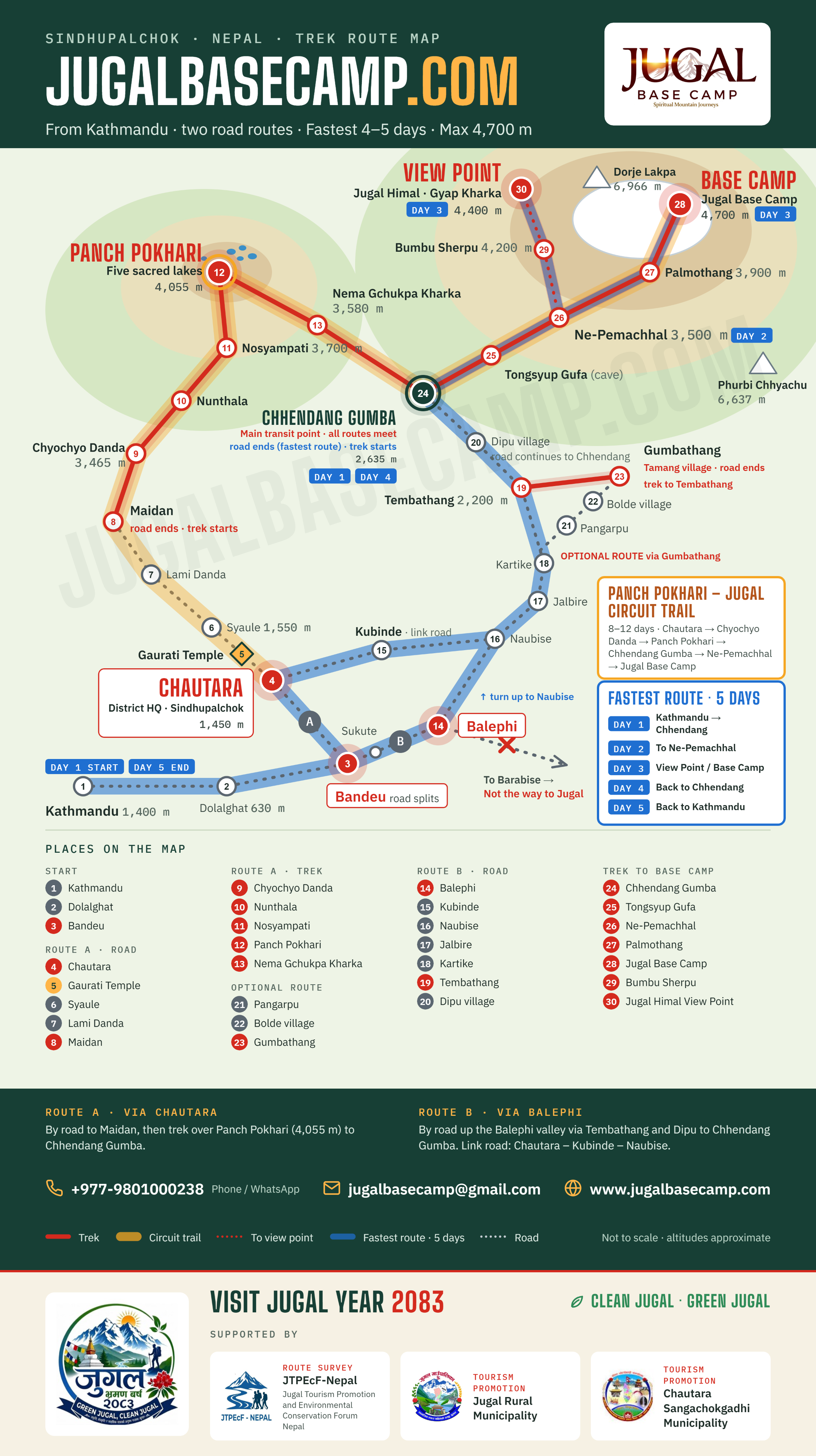
How to reach Jugal Base Camp (4,700 m) from Kathmandu – by road via Chautara or Balephi, then on foot through Chhendang Gumba, Ne-Pemachhal and Palmothang below Jugal Himal.
Because people always ask
Our cook team is honestly one of the best things about this trek, and we're not just saying that. Breakfasts: porridge, eggs cooked however you want, toast, jam, fruit, tea or coffee. Lunches: hot soup, noodles, sandwiches, local bread. Dinners: three courses — a proper starter, a main that rotates between Nepali, Indian, and occasionally pasta or fried rice, and dessert. Sitting down to dinner in a dining shelter at 4,000 metres while a cook who has hauled all of this up the mountain hands you a bowl of hot vegetable soup is genuinely one of the pleasures of this kind of travel.
Vegetarian, vegan, gluten-aware — all manageable with advance notice. Just tell us when you book.
No small print
Here's everything covered in the package price. We list it because we think you deserve to know what you're paying for before you pay for it.
Also worth knowing
We'd rather tell you this upfront than have you figure it out on the day of departure.
The honest breakdown
March and April are genuinely special on this route. The rhododendron bloom turns the lower trail sections into something out of a nature documentary — huge trees draped in crimson and white, the path running through colour for hours at a time. The mountains are clear, the temperatures are comfortable, and the wildlife is at its most active. April is the sweet spot: stable weather, full bloom, not too hot at lower elevations.
A note on May: as the pre-monsoon approaches, you start getting afternoon clouds building up from the south. Morning views are still often crystal clear, but the weather is less predictable. Still trekable, just less consistent than March-April.
Autumn is Nepal's most popular trekking window and the Jugal doesn't disappoint. The monsoon clears out all the haze and dust, leaving sky so blue it looks slightly fake. Mountain views are sharper than any other time of year. The air is cool and dry and genuinely invigorating — the kind that makes you want to walk faster. October is the golden month: stable weather, incredible visibility, and Dashain and Tihar festivals happening in the villages.
November is excellent too, just colder at the top end of the route. By late November the high camps can get properly cold at night. Still doable with the right sleeping bag, but worth knowing.
Heavy rain, leeches below 2,500 metres, and cloud cover that blocks mountain views for most of the day. We don't operate standard treks during monsoon. If you have a specific reason for wanting this window, contact us, but our honest advice is: pick another time.
The lower sections are trekable but the high camps and base camp are buried in snow and temperatures drop well below -20C. This is specialist territory requiring winter mountaineering experience. We can discuss it if that's your background, but it's not a route for general trekkers in winter.
'Moderate' is the grade, which in mountain trekking means you're walking 5-7 hours a day on uneven ground, gaining significant elevation over multiple consecutive days. It's physically real. It's also completely achievable for anyone who prepares properly.
People who have done this trek range from serious athletes to regular office workers who started walking regularly two months before departure. Both groups make it. The difference is how much they enjoyed it versus how much they suffered.
The youngest trekker we've taken on this route was twelve. The oldest was sixty-eight. Both made it to base camp. Age is less the issue than fitness and acclimatisation. Families with kids under ten should talk to us — we can modify itineraries, but it depends a lot on the specific children and the parents' assessment of their capability.
If you have any cardiac, respiratory, or blood pressure history, see your doctor before booking any high-altitude trek. Get a clearance letter if you can. Our guides are first-aid trained but they're not doctors, and the nearest hospital is hours away when you're up high.
Fair question. Nepal has hundreds of registered trekking operators, most of them perfectly competent, some of them excellent. Here's what's actually different about us — and we're being straight with you, not just listing vague claims.
We didn't put Jugal Base Camp on a booking platform and hire freelance guides to run it. We spent years establishing relationships with the communities along this specific trail, mapping the best campsite locations, figuring out the variations that work in different seasons, and building logistics that run smoothly when things don't go to plan. Most operators running 'off the beaten path' treks are running them on well-documented routes with a different branding. This one is genuinely ours.
Our guides grew up in these hills or neighbouring valleys. They went to school with people in the villages you pass through. They know which farmer will let us camp in his field, which trail variation avoids the mudslide from two years ago, and which campsite has the best sunrise angle in October. That knowledge is not in any guidebook. It's from growing up here.
28 government-licensed trekking guides — men and women, all from this area. Every one of them holds an official trekking guide licence, so you walk with people who are both trained professionals and true locals. Female travellers can request a female guide.
We also pay above-market wages, provide proper equipment and clothing to all team members, and direct a portion of every trek fee to JTPEcF-Nepal, a local NGO that works for the communities of this region. Your money stays in the mountains.
Supplemental oxygen on every trek. Pulse oximeters for daily monitoring. Wilderness First Responder certification for all lead guides, refreshed annually. Satellite communicator for when there's no cell signal. Emergency helicopter protocols that are practiced, not improvised. We have not had a serious safety incident on this route. We intend to keep that record by spending what it takes to maintain it.
Four-day version, seven-day version, solo, group, family, photography focus, slower pace for acclimatisation concerns, faster pace for experienced trekkers — we adapt. The standard itinerary is a starting point, not a constraint. If your situation doesn't fit the template, tell us what you need and we'll build something around it.
All enquiries answered within 24 hours. If something isn't right for you — wrong fitness level, wrong season, wrong expectations — we'll tell you rather than take your booking and deal with problems on the mountain. We'd rather lose a booking than have a trekker who shouldn't be on this route. That's not a noble stance, it's just practical.
The price we quote is the price you pay. We don't quote low and recover margin through permits charged at cost-plus, mandatory gear rentals, or pressure upgrades. What's in the includes list is in the price. What's in the excludes list is not. That's it.
We send a full gear list after booking. This is the condensed version of the things that actually matter.
Depends entirely on your fitness. We've had complete beginners complete this trek without major difficulty. We've also had beginners who were underprepared and had a harder time than they needed to. The honest answer is: if you follow a proper training programme for 6-8 weeks before you come, and you're generally healthy and active, you can do this. If you're planning to arrive off the couch, that's a different conversation.
Mild symptoms — headache, slight nausea, fatigue — are common above 3,500 metres and usually manageable with rest, hydration, and Diamox if you've brought it. Your guide monitors the group daily for symptoms and knows what to look for. Severe symptoms are rare but are treated immediately: descent, supplemental oxygen, and if necessary an emergency helicopter. We carry the equipment to manage this. You carry good insurance that covers helicopter evacuation.
We take solo trekkers regularly. On most departures there are other trekkers in a small group, so you won't be entirely alone. If you want a fully private solo trek — your own guide, your own schedule — that's available at a different price point. Contact us and we'll sort out the details.
Patchy on the lower trail, effectively none above 3,000 metres or so. We carry a satellite communicator for emergency use. Tell your family or partner the itinerary before you go and agree on check-in expectations. Most people find the disconnection one of the better parts of the experience in retrospect, even if it feels odd for the first day or two.
Some cloud and the occasional rain shower are normal even in prime season. Our guides make daily decisions based on actual conditions — not the original schedule. If weather makes it genuinely unsafe to continue to a planned camp, we adjust the route. We don't push groups into dangerous conditions. We also don't cancel treks over a bit of rain.
Yes, with the right planning. We'd suggest ten as a rough minimum age, but it depends heavily on the specific child — some ten-year-olds are more capable than adults. Contact us with details and we'll give you an honest assessment and a custom itinerary suggestion.
Tips aren't mandatory but they are meaningful. USD 5-10 per trekker per day, divided proportionally among the guide, assistant guides, cook, and porters, is the standard for a team that's done well. Your guide will walk you through the norm at the end of the trek if you want guidance. No pressure from our side either way.
Unlike the Everest or Annapurna corridors which are public trails, access to the upper Jugal route is managed through our established relationships with local communities and landowners. This is one reason the route stays uncrowded — it's not accessible to trekkers who just show up without a pre-arranged operator. When you trek with us, that access is secured as part of your package.
It's straightforward. We don't make it complicated.
Email us at jugalbasecamp@gmail.com, WhatsApp or call +977 9801000238, or use the contact form at jugalbasecamp.com. Tell us your preferred dates, number of people, and any specific questions. We respond within 24 hours.
Based on your dates and group, we'll send a tailored itinerary and price. This is a conversation, not a take-it-or-leave-it document. If something doesn't work, we adjust.
When you're ready to commit, a deposit locks in your dates and starts our logistics. Full payment details are shared at this point. We accept international bank transfers and major payment platforms.
You get our full briefing pack — detailed gear list, fitness guidance, permit info, everything you need to prepare. We're available throughout for any questions that come up between booking and departure.
Airport pickup, hotel recommendation if needed, evening briefing the night before the trek, and then we're off. From the airport to base camp and back, you're in good hands.